TMF Holds Fourth Tateshina Meeting to Advance Discussions and Initiatives Toward Realizing Zero Traffic Accidents
CHINO CITY, JAPAN
AUGUST 4, 2026
Toyota Mobility Foundation (Chairman: Akio Toyoda, hereinafter “TMF”) held the fourth Tateshina Meeting in Chino City, Nagano Prefecture, on July 18 to advance discussions and initiatives toward realizing zero traffic accidents.
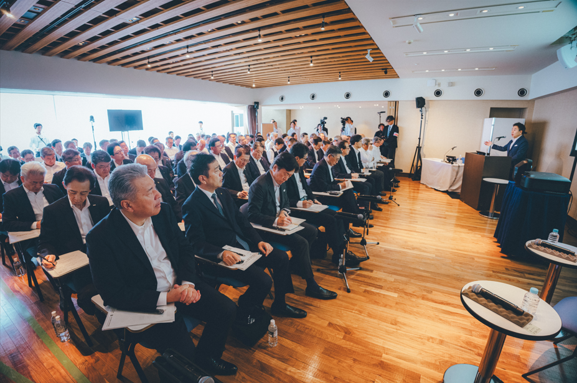
The fourth Tateshina Meeting (2026)
The Tateshina Meeting traces its origins to Shoko-ji Temple on Mt. Tateshina, which was established in 1970 as a place to pray for traffic safety. Since 2019, the meeting has served as a forum where leaders from across industries come together to explore what can be done to achieve zero traffic accidents and turn those ideas into action.
A Three-Pronged Approach Toward Zero Traffic Accidents
Although the number of fatalities and injuries resulting from traffic accidents in Japan has declined over the long term, progress has plateaued in recent years. To move beyond the limits of current measures, new approaches and fresh perspectives are needed.
Since its launch, the Tateshina Meeting has centered its discussions on the belief that achieving zero traffic accidents requires a three-pronged approach focusing on cars, people, and traffic infrastructure. In recent years, the Tateshina Meeting subcommittees have expanded these efforts through multifaceted initiatives and demonstration projects aimed at developing more effective traffic safety measures. 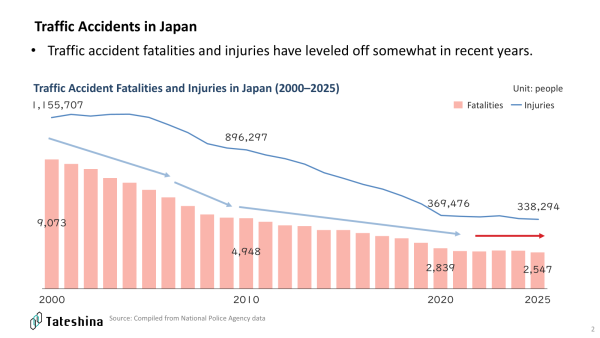
Source: Prepared by TMF based on data from the National Police Agency
At this year’s meeting, under the theme “Returning to Tateshina’s Origins—Turning Intent into Action,” participants revisited the history of Shoko-ji Temple and the prayer for traffic safety that lies at the heart of the meeting. They then discussed the challenges ahead and future directions for realizing zero traffic accidents from two perspectives: behavioral change and infrastructure coordination.
Details of the meeting are as follows:
Overview of the Fourth Tateshina Meeting
Date & Time: Saturday, July 18, 2026, 9:00–10:30 a.m.
Theme: Returning to Tateshina's Origins—Turning Intent into Action
Facilitator: Goro Okazaki, motor journalist and TMF Board Member
Session 1: Initiatives and Challenges in Promoting Behavioral Change
Session 2: Preventing Unexpected Accidents Through Infrastructure Coordination
Participants: Approximately 80 representatives from companies and organizations, including Toyota Motor Corporation, 17 Toyota Group companies and affiliated companies, representatives of the Toyota Motor Dealers Association, the Japan Automobile Manufacturers Association, Inc. (JAMA), Suzuki Motor Corporation, SUBARU CORPORATION, Mazda Motor Corporation, Honda Motor Co., Ltd., Aioi Nissay Dowa Insurance Co., Ltd., Sompo Japan Insurance Inc., Tokio Marine & Nichido Fire Insurance Co., Ltd., Mitsui Sumitomo Insurance Company, Limited, Bridgestone Cycle Corporation, Panasonic Cycle Technology Co., Ltd., KDDI CORPORATION, KYOCERA Corporation, Institute of Science Tokyo, and others.
At the opening of the meeting, Masashi Yamaguchi, Chairman of the Board of Aichi Toyota EAST/WEST, spoke about the origins of Shoko-ji Temple and the traffic safety initiatives undertaken by Toyota dealerships. Participants reflected on the aspirations of those who came before them and reaffirmed that, even though the number of traffic fatalities in Japan has fallen to a record low, the goal is not merely to reduce accidents but to eliminate them entirely. They also reaffirmed the importance of translating the spirit of prayer and altruism into concrete action.
Building on this shared understanding, participants exchanged views on the following approaches toward realizing zero traffic accidents.
Session 1: Initiatives and Challenges in Promoting Behavioral Change
Focusing on two priority areas identified at last year's Tateshina Meeting—traffic safety for seven-year-old children, who face a particularly high risk of traffic accidents, and safe driving among older drivers—Goro Okazaki, motor journalist and TMF Board Member, introduced the initiatives undertaken by the subcommittees and the challenges they have identified.
Children
Report:
The subcommittees developed and tested tools that simulate road hazards and a parent-child learning app. They also conducted outreach lessons at elementary schools and implemented initiatives to raise awareness of traffic accidents involving seven-year-old children. Together, these efforts demonstrated encouraging results and measurable effectiveness.
Challenges:
Create opportunities for children to learn about traffic safety continuously and naturally at home, at school, and in their local communities.
Build a social framework in which everyone shares responsibility for protecting children.
Older Drivers
Report:
To support safe driving, the subcommittees conducted demonstration projects combining driving assessments based on dashcam footage, group reflection sessions in local communities and other settings, and initiatives linking driving with health. The results showed that combining group reflection with health promotion helped increase participants' acceptance of the assessment results.
Challenges:
Foster greater public understanding that driving assessments should serve as a means of supporting and improving people's daily lives, rather than simply determining whether they should continue driving.
Explore ways to provide ongoing support that enables older drivers to continue driving safely for as long as possible, rather than assuming they should stop driving.
Session 2: Preventing Unexpected Accidents Through Infrastructure Coordination
Against the backdrop of rapid advances in communications and sensing technologies, participants discussed how to realize a three-pronged approach to traffic safety through coordination among people, cars, and traffic infrastructure.
Hiroki Nakajima, Toyota Motor Corporation Executive Vice President and TMF Board Member, noted that technological advances by automakers have significantly improved vehicle safety over the years. He also pointed out that even as automated driving technologies continue to evolve, vehicles alone remain physically unable to prevent certain types of accidents, such as those involving pedestrians suddenly emerging from blind spots. While emphasizing the importance of continuing to improve vehicle safety, he highlighted the potential of infrastructure coordination technologies using smart poles, which can detect hazards beyond a vehicle's field of view at an early stage, as one way to further enhance traffic safety.
Participants also highlighted the potential of technologies that use smartphones and bicycle-mounted devices to alert not only drivers, but also pedestrians and cyclists to potential hazards and encourage safer behavior. At the same time, they noted the challenges of promoting behavioral change among people, whose actions are influenced by emotions. The discussion also explored the potential of using AI to analyze data collected from infrastructure, vehicles, smartphones, and other devices to predict human behavior, helping to prevent accidents before they occur while also identifying the factors behind risky behavior.
The meeting also addressed the challenges that must be overcome to enable the practical implementation of these technologies, including communication standards, responsibility for infrastructure development, cost sharing, and frameworks for data sharing. Participants confirmed the importance of bringing together technologies and expertise from a wide range of fields, including high-speed communications infrastructure, safety devices for cyclists and pedestrians, and safety assessments using accident data from insurance companies, as well as advancing demonstration projects in collaboration with local Toyota dealerships and other community partners. The meeting concluded with a renewed commitment to taking action in each participant's respective field and accelerating a three-pronged approach through infrastructure coordination toward realizing zero traffic accidents.
Through this year's discussions, participants reaffirmed the role of the Tateshina Meeting as a forum for advancing cross-industry initiatives, such as infrastructure coordination. Looking ahead, the Tateshina Meeting will remain rooted in its founding spirit of prayer for traffic safety, bringing together diverse stakeholders to put the shared belief that "traffic safety is everyone's responsibility" into action.
Inquiry
Toyota Mobility Foundation - Tateshina Conference Inquiries – Contact Form
Since its founding, Toyota Motor Corporation has conducted its business activities with the aim of creating a prosperous society through automobiles, while respecting all stakeholders, including customers, business partners, employees, and local communities.
TMF was established in August 2014 with the aim of engaging in activities that serve the public interest. To contribute to the creation of a prosperous society through mobility, TMF undertakes a wide range of projects worldwide, including initiatives to address mobility-related challenges.
